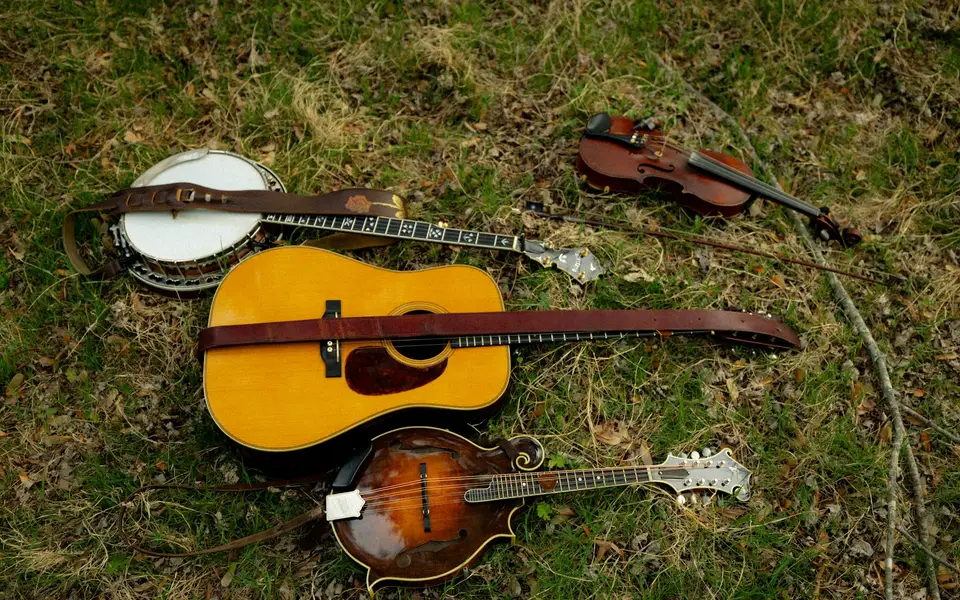
D thirteenth (D13) chord on mandolin
The D thirteenth chord (D13) is a thirteenth chord (a dominant ninth plus a major thirteenth), made of six notes: D – F♯ – A – C – E – B.
Tap a string on a diagram to hear just that string. The sound is generated in your browser with a physical string model.
What the D13 chord sounds like
A thirteenth chord is a dominant seventh with an added major thirteenth (the sixth an octave up). On an instrument the fifth and often the ninth are dropped, and the eleventh is left out. A classic jazz and blues dominant.
Notes of the D13 chord
| Degree | Note | Interval from the root |
|---|---|---|
| 1 | D | root |
| 3 | F♯ | major third (4 semitones) |
| 5 | A | perfect fifth (7 semitones) – often omitted on fretted instruments |
| 7 | C | minor seventh (10 semitones) |
| 9 | E | major second (2 semitones) – often omitted on fretted instruments |
| 13 | B | major sixth (9 semitones) |
How to play it – with fingering
Basic shape
- String 1 (E): fret 2, index finger (F♯5)
- String 2 (A): fret 3, middle finger (C5)
- String 3 (D): open (D4)
- String 4 (G): fret 4, ring finger (B3)
Position 4
- String 1 (E): fret 7, little finger (B5)
- String 2 (A): fret 5, ring finger (D5)
- String 3 (D): fret 4, index finger (F♯4)
- String 4 (G): fret 5, middle finger (C4)
Position 7
- String 1 (E): fret 8, middle finger (C6)
- String 2 (A): fret 9, little finger (F♯5)
- String 3 (D): fret 9, ring finger (B4)
- String 4 (G): fret 7, index finger (D4)
Tuning: G D A E, like a violin; every note is a pair of strings that you fret together. In the diagram, × means the string is not played, and a circle means an open string.
Which keys is it in?
The D13 chord is built from the notes of these keys (for minor keys, both the natural and the harmonic minor are considered):
- G major: V13 (dominant)
- E minor: VII13
Similar chords and substitutes
If D13 is too hard, or you want a different colour in the same spot, these chords are worth a try.
Substitutes (by function)
Frequently asked questions
What notes are in the D13 chord?
D, F♯, A, C, E, B. The root is D; the intervals of the other notes from the root: major third, perfect fifth, minor seventh, major second, major sixth.
What is the easiest way to play D13 on mandolin?
The easiest shape above is “Basic shape”, rated easy. We show 3 shapes, from open and easy versions to movable barre shapes higher up the neck.
How do I read the chord diagram?
Strings run from the lowest (left) to the highest (right) – tick “Left-handed” to mirror it. Rows are frets; a number at the side shows the starting fret. Dots are fingers (1 index, 2 middle, 3 ring, 4 little), a long bar is a barre, × means don't play that string and ○ means play it open.
Why is a note missing from some D13 shapes?
On a fretted instrument you can't always play every note of a 6-note chord. The fifth (A) and ninth (E) may be dropped – the chord keeps its character without them.
How is the D13 chord written?
The chord symbol is D13, and its full name is D thirteenth.
Related chords
The same chord on another instrument:
D13 on guitarD13 on pianoD13 on ukuleleD13 on banjo
Other D chords on mandolin:
DDmD7Dmaj7Dm7Dsus2Dsus4D7sus4D6Dm6Dadd9DdimDaugDdim7Dm7b5D9Dm9Dmaj9D11
Practise with us
Music tools for practice
Tune up, keep time and train your ear – free, no sign-up, right in your browser.
 Guitar tunerUses your mic, accurate to the cent – guitar, bass, ukulele, violin.Try it →
 Chord finderNames any chord from its notes or from a shape.Try it →
 MetronomeTime signatures, accents, subdivisions and tap tempo.Try it →
 Chord progression generatorChord progressions in any key, with playback.Try it →
 Ear trainerIntervals, chords and scales – step by step, like a game.Try it →
 Online pianoPlay in your browser with mouse, keyboard or MIDI.Try it →
Photos: Isak Photography, 42 North, Rachel Loughman, Vitaly Gariev, Vitaly Gariev, Isaac Martin / Unsplash